
The Montgomery Cares (MCares) program provides access to comprehensive health services for more than 20,000 low-income, uninsured residents of Montgomery County each year and generally meets or exceeds national care quality benchmarks for Medicaid providers. Together, those data points indicate the program succeeds in helping nearly 2% of county residents stay healthy every year. But how do those outcomes compare to the level of need in the community? Are there gaps in our provider networks that leave out some of the very residents we aim to serve? To find out, the Montgomery County Department of Health and Human Services and the Primary Care Coalition (PCC) partnered with NORC at the University of Chicago to conduct a Montgomery Cares Network Adequacy study and report on the results.
Those results [1] were largely positive, particularly in terms of the program’s reach. Of the estimated 25,775 Montgomery County residents potentially eligible for the program between 2021 and 2023, MCares actually served 23,539 of them—or 91% — with a caveat that results are based on census data and may undercount the potentially eligible population. It also generally met Maryland Medicaid network standards (15-minute drive, 10 mile distance), though the report noted a subset of patients (<15%) did not select the closest partner clinic as their medical home. The table below offers a comparison of MCares results to Medicaid time standards as reported in the final report.
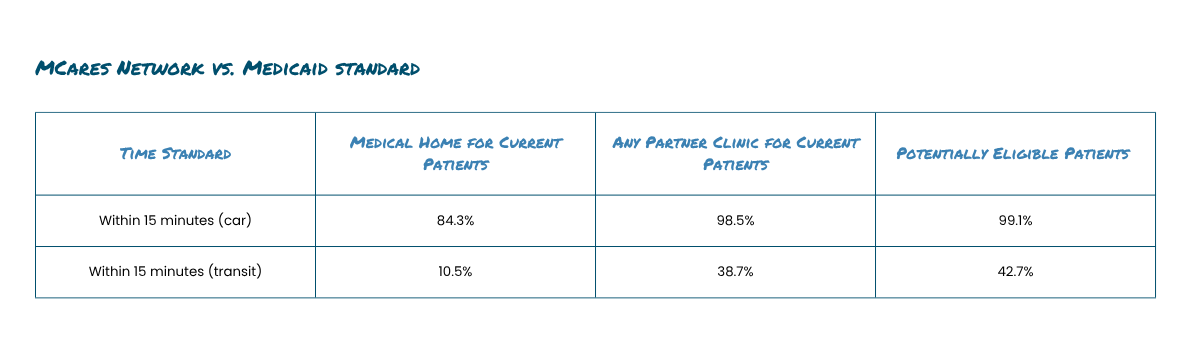
One challenge noted was for accessibility by public transit. When applying the Medicaid network standards to public transit routes, only 39% of participants had adequate access to any partner health center and even fewer (10%) had adequate access to their preferred health center. However, the report noted several clinic partners have existing programs to fund transport through ride share services. The accessibility results by car are positive: “Given the distribution of patients and health centers, it appears that participating health centers are well situated to serve both the current and eligible patient population.” However, the local public transportation infrastructure does not adequately support patients without access to a vehicle in timely transit to the safety-net clinics.
However, there remain areas for improvement, particularly in access to specialty care, which faces substantially longer wait times than for primary care visits. Patients also noted that appointments during nontraditional operating hours would make access easier, though 58.8% of patients surveyed reported 9:00 am – 5:00 pm on weekdays as their desired appointment window. (Weekday mornings from 6:00 am – 8:00 am was the most popular window for nontraditional hours of operation, selected by 31.4%.) And 22% of patients surveyed responded that “more money to pay for visits and medicine” would improve access, despite the relatively low patient cost of MCares (there are no monthly premiums, and co-pays are capped at $35/visit for patients at or below 100% of the federal poverty level).
Other results of note, include:
- Participants most commonly reported using the hospital/ER as an alternative source for care, a result that underscores the importance of the healthcare safety net as an investment in hospital diversion.
- The overwhelming majority of participants (71%) found the MCares program through their personal networks, rather than through formal outreach or referral programs.
- The study also reported on predictive modeling of utilization over fiscal years (FY) 2025 and 2026 [2]. Results indicated the number of encounters will approach the budgeted 72,000 encounters for FY25 and grow to more than 74,000 in FY26. The degree of increase predicted for FY26 will increase program budget needs.
Perhaps the most important takeaway: patient trust in our clinic partners is strong. “Patients widely shared that they trusted the medical advice offered by their providers and felt empowered to make decisions about their healthcare,” the accompanying Survey and Focus Group Summary [3] noted, “affirming that providers were easy to understand and explained concepts well.”
This article has not been reviewed or approved by the Montgomery County Department of Health and Human Services.
End Notes
1. NORC at the University of Chicago. Montgomery Cares Program (MCares) Network Adequacy Assessment: Final Report. May 2024.
2. NORC at the University of Chicago. Montgomery Cares Program (MCares) Patient and Encounter Projections for Fiscal Years (FYs) 2025 and 2026: Final Report. May 2024.
3. NORC at the University of Chicago. Montgomery Cares Program (MCares) Network Adequacy Assessment Patient Voice: Survey + Focus Group Summary Final Report. May 2024.